
100 t/h C&D Waste Recycling Plant in Australia
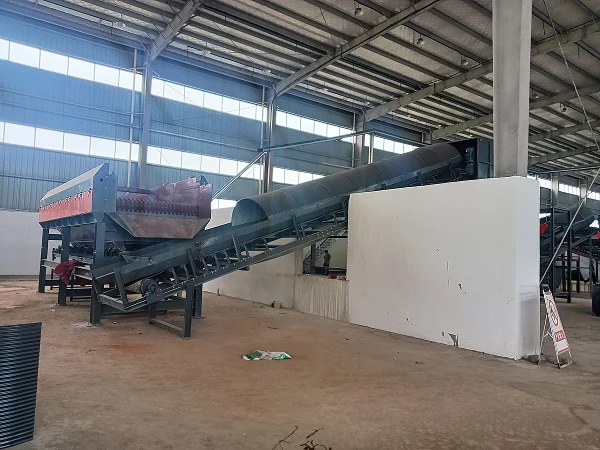
Project Details
- Location: Australia
- Commissioning Date: September 2026
- Processed Material: Mixed construction and demolition (C&D) waste
- Processing Capacity: 100 t/h under continuous, stable operating conditions
- Application: Processing C&D waste into recycled aggregate products while recovering scrap steel and reducing landfill volumes and disposal costs. The recycled aggregates can be used for road subgrade fill, precast construction products, and site backfilling
Project Overview
Commissioned in September 2026, this 100 t/h C&D waste recycling plant in Australia processes mixed demolition debris into recycled aggregates of different sizes while recovering ferrous metals. The production line combines multi-stage crushing, magnetic separation, air separation, and screening to separate reusable materials from mixed construction waste.
Hongzhi designed and supplied the complete processing system based on the composition of the incoming waste, the required 100 t/h capacity, and site conditions.
Project Requirements
The customer operates in building demolition, solid waste collection and transportation, and recycled aggregate production.
The project was designed to achieve two main objectives:
- Process mixed C&D waste into recycled aggregates of different particle sizes.
- Recover ferrous metals, including reinforcing steel bars and steel wire, from the waste stream.
Feed Materials & Processing Challenges
The incoming waste consists primarily of concrete rubble, bricks, tiles, sand, and gravel, mixed with reinforcing steel, steel wire, wood, plastic film, foam, and textiles. Small amounts of soil and damp mortar are also present, with the largest incoming pieces measuring up to 1,000 mm.
The mixed composition presents several processing challenges:
- Large Material Sizes: Oversized C&D debris requires multiple crushing stages to achieve suitable particle sizes for further processing.
- Embedded Ferrous Metals: Reinforcing steel and other ferrous metals may remain embedded in concrete, making a single magnetic separation stage insufficient. Therefore, two-stage magnetic separation is used to improve metal recovery.
- Mixed Lightweight Contaminants: Wood, plastics, foam, and other lightweight materials must be separated from the mineral aggregates through air separation.
- Different Aggregate Size Requirements: The processed aggregates require further screening and classification to produce different size fractions for reuse.
Process Flow
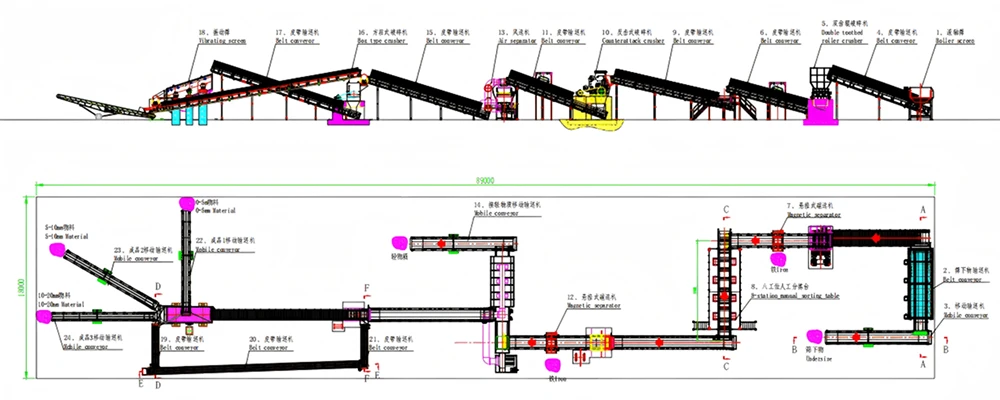
The recycling line integrates pre-screening, primary crushing with a double toothed roll crusher, manual sorting, two-stage magnetic separation, impact crushing, air separation, aggregate shaping with a box-type crusher, and final vibrating screening.
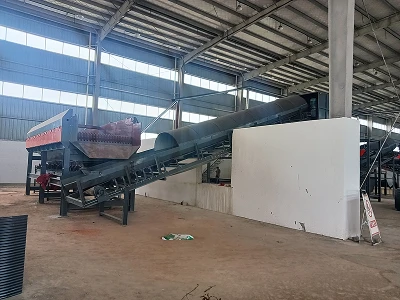 Disc Screen
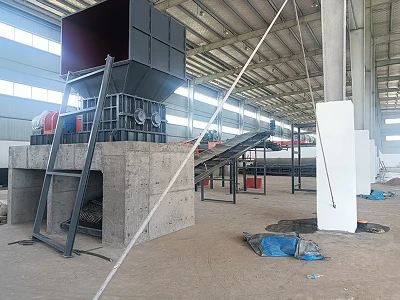 Double Toothed Roll Crusher
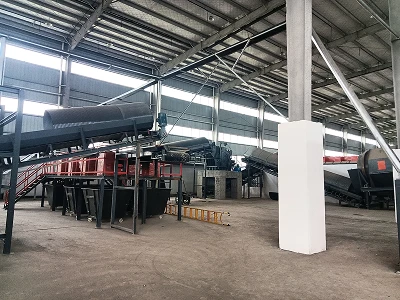 Manual Sorting Conveyor
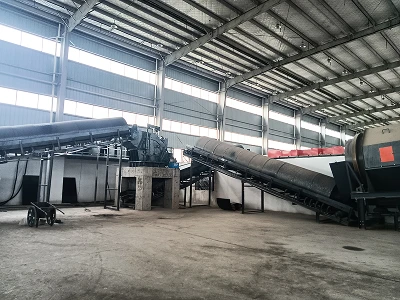 Impact Crusher
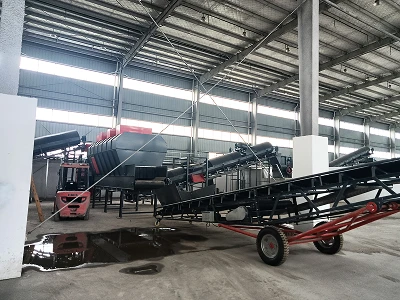 Air Separator
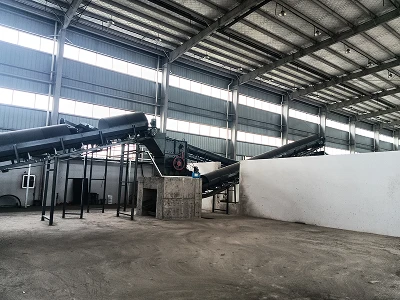 Box-Type Crusher
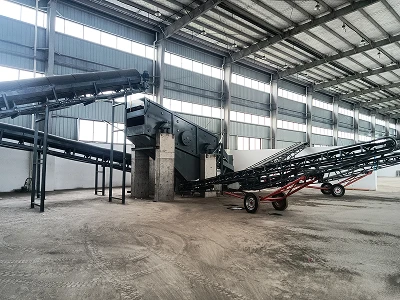 Vibrating Screen
Technical Specifications
- Processing Capacity: 100 t/h
- Overall Line Dimensions: (L × W × Max. H): 90 × 20 × 6 m
- Operating Mode: Continuous automated operation with manual sorting assistance
- Recycled Aggregate Sizes: 0-5 mm, 5-10 mm, 10-20 mm
- Ferrous Metal Recovery Rate: ≥ 95% (recovery of scrap rebar and steel wire)
- Lightweight Contaminant Removal Rate: ≥ 93% (separation of plastics, foam, and wood)
Project Requirements
The completed recycling line processes mixed C&D waste through crushing, ferrous metal recovery, lightweight contaminant removal, and particle-size classification. It produces three recycled aggregate fractions (0-5 mm, 5-10 mm, and 10-20 mm), while recovering ferrous metals from the waste stream.
The project demonstrates Hongzhi's ability to configure integrated recycling systems for large, heavily contaminated demolition waste, combining multi-stage crushing, two-stage magnetic separation, air separation, and aggregate screening to support material recovery and reuse.